Often described as “assisted yoga,” Thai massage is active rather than passive. A closer look at its origins, what it offers, and how a session unfolds.
Thai massage stands apart from most other massage styles — it's active rather than passive, performed on a mat rather than a table, and draws as much from yoga and stretching as it does from traditional bodywork. Often described as “assisted yoga,” it's one of the most physically engaging forms of massage therapy. Here's a closer look at its origins, what it offers, and how a session actually unfolds.
A Brief History
Thai massage, known in Thai as Nuad Boran (“ancient massage”), traces its roots back more than 2,500 years to the traditions of Ayurvedic medicine in India and traditional Thai medicine. It's traditionally attributed to Jivaka Kumar Bhaccha, a physician said to have been a contemporary and personal doctor of the Buddha, who is honored in Thailand as the “father of medicine.”
As Buddhism spread from India into Southeast Asia, so did healing practices connected to it, blending with local Thai traditions of herbal medicine and energy-based healing over the centuries. Thai massage developed within Buddhist temples, where monks practiced it as a form of healing rooted in compassion and spiritual care rather than simple relaxation.
The practice draws on the concept of Sen lines — energy pathways in the body similar to the meridians of Traditional Chinese Medicine or the nadis of Indian yogic tradition. Historically preserved and passed down through monastic and family lineages, Thai massage was eventually formalized into structured teaching systems, most notably at Wat Pho Temple in Bangkok, which remains one of the most respected centers for traditional Thai massage education today.
The Benefits
Thai massage offers a distinct set of benefits shaped by its active, stretch-based approach.
Improves flexibility and range of motion — The assisted stretching involved in Thai massage gently guides joints and muscles through their full range of motion, often improving flexibility more noticeably than passive massage styles.
Relieves muscle tension and stiffness — Rhythmic compression along the body's energy lines helps release tight muscles, particularly in the back, hips, and legs.
Boosts circulation and energy flow — Based on traditional concepts of energy pathways, Thai massage aims to clear blockages along the Sen lines, which practitioners believe supports better circulation and overall vitality.
Reduces stress and promotes mental clarity — Despite its physical intensity, Thai massage has a meditative quality; the rhythmic pressure and stretching can quiet the mind as effectively as more passive relaxation techniques.
Supports better posture — By loosening tight muscles and improving joint mobility, regular sessions can help counteract the effects of prolonged sitting or repetitive movement patterns.
Enhances athletic recovery — Many athletes use Thai massage to relieve muscle tightness, improve mobility, and recover faster between training sessions.
No oils required, fully clothed — Because Thai massage doesn't use oil and is performed with the client in loose, comfortable clothing, it's an accessible option for those who prefer not to disrobe for treatment.
The Methodology
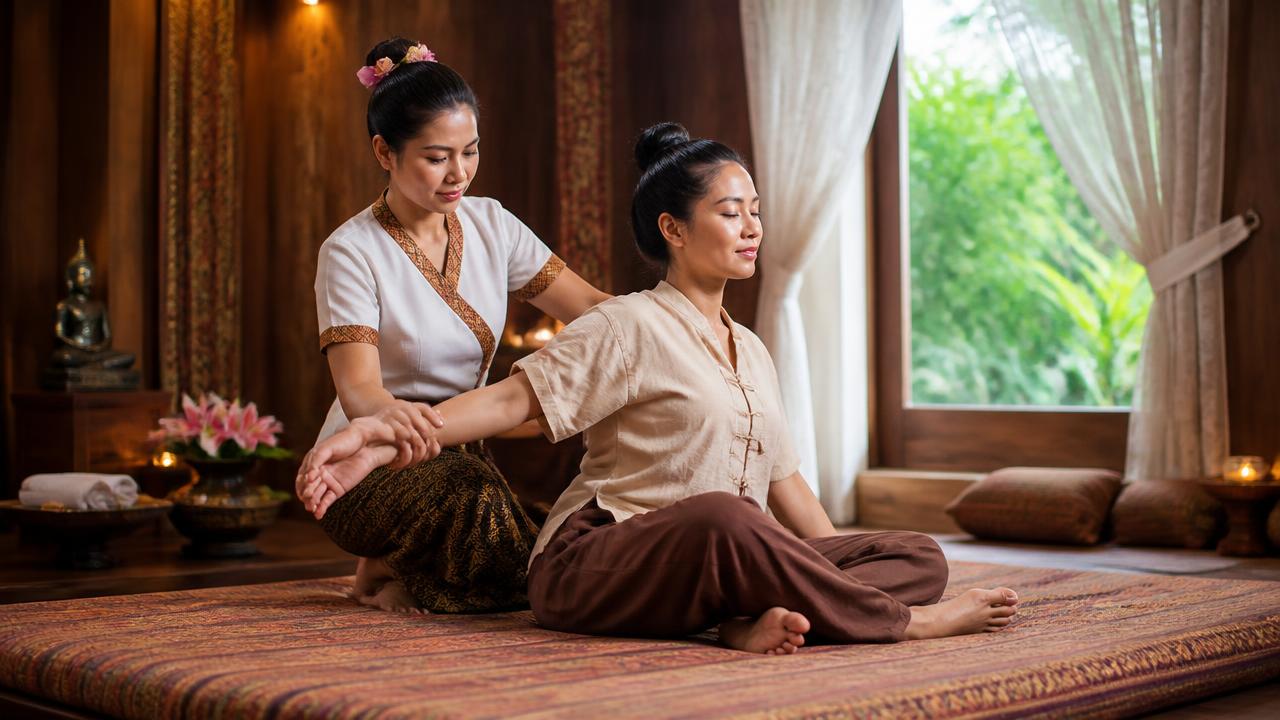
Unlike Swedish or deep tissue massage, Thai massage doesn't take place on a table — sessions are performed on a padded mat on the floor, allowing the practitioner to use their hands, knees, legs, and feet to move the client's body.
1. Rhythmic compression — The practitioner applies firm, rhythmic pressure using palms, thumbs, and feet along the body's Sen lines, working from the feet upward (or head downward, depending on tradition) to release tension and stimulate energy flow.
2. Assisted stretching — Drawing heavily from yoga postures, the practitioner guides the client's body into a series of stretches — often described as being “moved like a doll” — to open joints, lengthen muscles, and improve flexibility. This can include stretches for the hips, spine, shoulders, and legs.
3. Joint mobilization — Gentle rocking, pulling, and rotational movements are used to mobilize joints, particularly the shoulders, hips, and spine, improving range of motion over time.
4. Rhythmic rocking — Slow, steady rocking motions are woven throughout the session to help the client relax between more active stretching and compression sequences.
5. Sequential, full-body flow — A Thai massage session typically follows a set sequence, starting at the feet and moving methodically up through the legs, hips, back, arms, shoulders, and head — often finishing with facial and scalp work to complete the full-body treatment.
A full Thai massage session typically lasts 60–120 minutes, longer than many other massage styles, due to the comprehensive, full-body nature of the technique. Clients remain fully clothed throughout, usually in loose cotton clothing provided by the spa.
Final Thought
Thai massage offers something genuinely different from most spa treatments — a blend of bodywork, stretching, and energy-based tradition that leaves clients feeling both physically loosened and mentally calm. For anyone looking to combine the benefits of massage with the mobility gains of assisted stretching, it remains one of the most distinctive and effective options available.